Listening-first ChineseYou can still sing a song from ten years ago, word for word. But the twenty Chinese words you "learned" on Monday are gone by Tuesday. Vocoplay turns that quirk of your memory into your study plan.
Lo-fi for the commute, rap for the gym, pop for the shower. Your vocabulary, your soundtrack.
You downloaded a flashcard app. You drilled 我, 你, 好 like a champion for three weeks. Then life happened, you missed four days, and the app greeted you back with 412 cards due. So you closed it. Possibly forever. Sound familiar?
Melody is a filing system. Rhythm, rhyme and repetition are the exact hooks your memory uses to keep things for decades — it's why an ad jingle you actively hate still lives rent-free in your head. A flashcard gives your brain no reason to hold on. A song you genuinely like begs to be replayed, and every replay is a rep you never had to force.
No toddler ever conjugated a verb before speaking. They listened — for months — to the same words wrapped in song, rhythm and repetition, until the meaning just clicked. Then they spoke. Somewhere along the way we decided adults should do the opposite: memorize rules cold, and maybe listen later. How's that been going?
The fastest way to make a sound yours is to copy it the second you hear it — no pause to translate, no time for your inner critic. That's shadowing, the trick actors and interpreters lean on: you echo the line while the melody is still ringing, matching the rhythm, the stress and the tones.
Not "fluent in 7 days" — we'll leave that to the ads. Here's the honest version, level by level.
Pick a style and a song is built from your first ten words (家, 你, 是, 好…). Minutes later you understand a full line of Mandarin — characters, sound and meaning.
Every seventh level is a Review gate before the next batch unlocks. Nothing to cram — if the songs did their job you breeze it; if a word slipped, you replay and pass. That's the whole study session.
A few hundred words in. You read a sign, catch a lyric in a song that isn't ours, and order something without pointing at the picture. Small wins, but they're real and they're yours.
Whole phrases arrive as meaning, not as a puzzle. You follow chunks of a C-pop song with the subtitles off and hold a simple back-and-forth chat without freezing.
You think in little Chinese phrases. You're no longer "studying Chinese" — you speak some, and you got there one song-sized level at a time. How else would you have wanted to spend the time?

Every track is generated around the words you're actually learning, in a genre you'll willingly replay — not a playlist of dread.
Characters, pinyin and meaning on every line. Tones are color-coded so your eyes learn mā vs. mǎ before your mouth has to.
Sing along to synced lyrics while we listen for the right sounds and tones — points for accuracy, not just confidence.
Catch falling words, match them by ear, race the clock. It's vocabulary practice your brain mistakes for a game.
Say the phrase and find out whether mǎ landed as "horse" or "mother" — before you test it on a native speaker.
New vocabulary and a new song daily, so you build a streak instead of a pile of guilt.
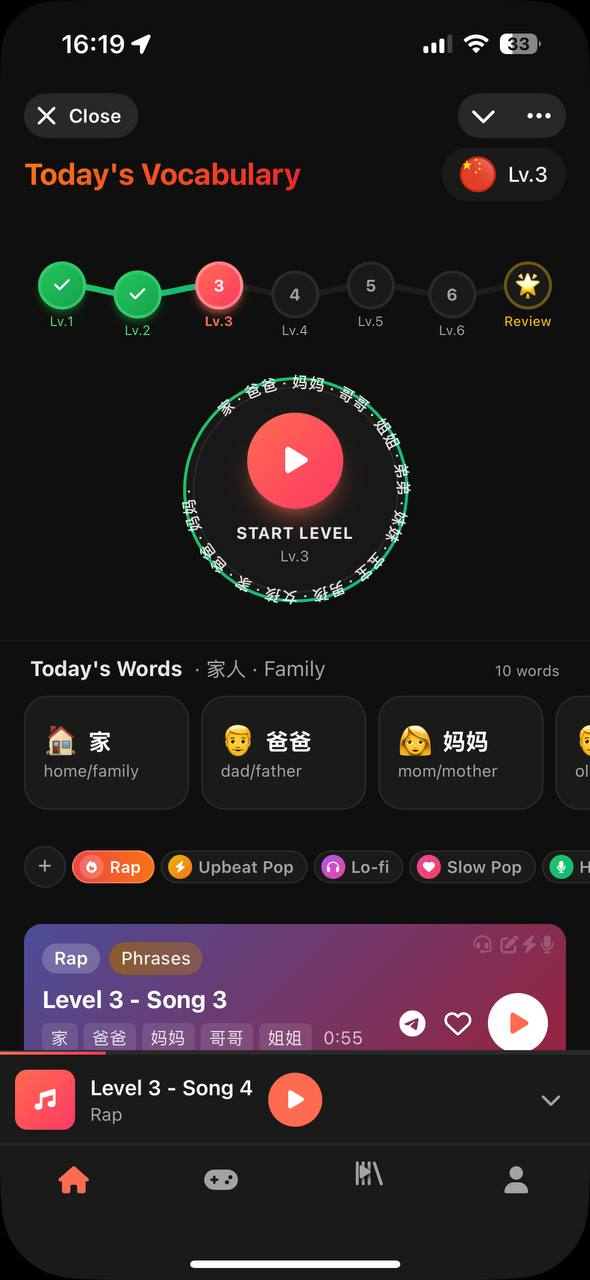
The home screen — your level, today's words, and the song built from them.
Mini-games and XP, because your brain works harder when it thinks it's winning.
Karaoke with synced lyrics and translations — sing the line, learn the line.
"You are my moon" — five words you'll never need to flashcard, because you'll be singing them.
Open the bot, pick a beat, and learn your first Chinese line before this page finishes loading on a bad connection.
Open Vocoplay in Telegram